
Primary vs Secondary Evidence in USCIS RFEs: What Really Wins Approval
Blog post description.
1/25/20263 min read
Primary vs Secondary Evidence in USCIS RFEs: What Really Wins Approval
When USCIS issues a Request for Evidence (RFE), one distinction quietly determines whether your response succeeds or fails:
Primary evidence vs secondary evidence.
Most applicants do not understand this difference. They assume that if they submit something, USCIS will consider it. In reality, USCIS applies a clear hierarchy to evidence — even when it does not explicitly say so.
This article explains what primary and secondary evidence really are, how USCIS evaluates them in RFEs, and how to use each correctly to avoid denial.
Why Evidence Hierarchy Matters in RFEs
An RFE is issued because USCIS believes the current evidence is insufficient. At this stage, officers are not neutral — they are cautious.
They are asking:
“Is there reliable, objective proof that clearly meets the legal requirement?”
Understanding evidence hierarchy allows you to answer that question correctly.
What USCIS Considers Primary Evidence
Primary evidence is the strongest possible proof. It comes directly from the original source responsible for the record.
USCIS trusts primary evidence because:
It is official
It is difficult to manipulate
It exists independently of the applicant
Examples of primary evidence include:
Certified government records
Official tax transcripts
Civil registry documents
Original employer records
Primary evidence speaks for itself. It requires little explanation.
Why USCIS Strongly Prefers Primary Evidence
USCIS officers are trained to rely on documentation that:
Was created at the time of the event
Comes from authoritative sources
Can be independently verified
Primary evidence reduces doubt.
When doubt disappears, approval becomes possible.
What USCIS Considers Secondary Evidence
Secondary evidence is used when primary evidence is unavailable.
It includes:
Affidavits
Letters from individuals
Supporting documents
Alternative records
Secondary evidence is not weak by default — but it requires context.
USCIS treats secondary evidence as acceptable only when properly justified.
The Biggest Mistake With Secondary Evidence
The most common mistake applicants make is submitting secondary evidence without explaining why primary evidence is missing.
To USCIS, this looks like:
Avoidance
Incompleteness
Weak credibility
Secondary evidence without explanation is often ignored.
When Secondary Evidence Works Well
Secondary evidence can be effective when:
Primary evidence does not exist
Records were destroyed
Authorities refuse to issue duplicates
Circumstances are outside your control
In these cases, USCIS expects:
A clear explanation
Proof of attempts to obtain primary evidence
Consistent, detailed secondary documentation
Affidavits: The Most Misused Evidence Type
Affidavits are widely misunderstood.
USCIS values affidavits when they:
Come from individuals with direct knowledge
Explain how the person knows the facts
Include specific details
Are signed and dated
USCIS discounts affidavits when they:
Repeat your claims
Lack detail
Replace required documents
Appear scripted
Affidavits support evidence — they do not replace it.
Why Replacing Primary Evidence With Affidavits Backfires
Applicants sometimes think:
“I’ll explain it instead.”
USCIS does not accept explanations as substitutes for required records unless the law explicitly allows it.
If primary evidence exists and you fail to submit it, secondary evidence rarely saves the case.
The Role of “Unavailability” Explanations
When primary evidence is missing, USCIS expects you to explain:
Why it is unavailable
What steps you took to obtain it
Why those steps failed
This explanation must be:
Factual
Specific
Supported by documentation if possible
Vague explanations are treated as noncompliance.
How USCIS Evaluates Competing Evidence
When USCIS sees:
One piece of primary evidence
Versus multiple pieces of secondary evidence
The primary evidence usually wins.
Quality beats quantity.
Mixing Primary and Secondary Evidence Correctly
The strongest RFE responses often combine:
Primary evidence (where available)
Secondary evidence (to reinforce or clarify)
This layered approach:
Builds credibility
Resolves doubt
Strengthens weak areas
Financial RFEs: Primary vs Secondary Proof
Primary financial evidence:
IRS transcripts
Official payroll records
Secondary financial evidence:
Employer letters
Bank statements
USCIS expects primary proof first. Secondary proof supports — not replaces — it.
Relationship RFEs: Evidence Hierarchy in Practice
Primary relationship evidence:
Marriage certificates
Joint legal documents
Secondary relationship evidence:
Photos
Messages
Statements
Photos without primary documentation rarely succeed.
Employment-Based RFEs: What USCIS Trusts
Primary employment evidence:
Employer-issued records
Contracts
Government filings
Secondary employment evidence:
Personal statements
Informal emails
USCIS heavily favors employer and government documentation.
Why “More Evidence” Doesn’t Fix Weak Evidence
Applicants often flood USCIS with:
Screenshots
Informal letters
Self-written statements
This does not elevate secondary evidence to primary status.
More weak evidence does not become strong evidence.
How Officers Decide Evidence Sufficiency
USCIS officers ask:
“Is the strongest available evidence present?”
If primary evidence exists and is missing, denial is likely.
If primary evidence does not exist and secondary evidence is credible and well explained, approval is possible.
The Danger of Pretending Primary Evidence Doesn’t Exist
If USCIS believes:
Primary evidence should exist
But was not provided
They may question credibility.
Honesty about availability matters.
How Successful Applicants Use Evidence Hierarchy
Approved applicants:
Identify what primary evidence exists
Submit it clearly
Explain unavailability honestly
Use secondary evidence strategically
They do not hope secondary evidence will “carry” the case alone.
Turning Evidence Hierarchy Into a Strategy
Once you understand hierarchy:
Decisions become easier
Responses become focused
Risk decreases
You stop guessing and start aligning with USCIS expectations.
The Smart Next Step
If you’re unsure whether your RFE response relies too heavily on secondary evidence, do not guess.
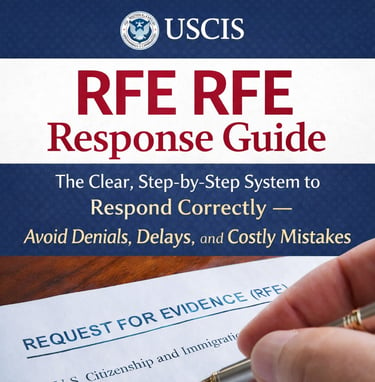
👉 The USCIS RFE Response Guide shows you how to choose the right evidence, explain unavailability properly, and build responses USCIS actually approves — in over 60 pages of practical, step-by-step guidance.
Evidence hierarchy is not optional. It is decisive.
Final Thought
USCIS does not deny cases because applicants submit secondary evidence.
They deny cases because applicants submit secondary evidence without justification.
Understand the hierarchy. Use it correctly. Protect your case.https://uscissrfehelpusa.com/uscis-rfe-guide
Help
Guiding you through every step smoothly
Contact
infoebookusa@aol.com
© 2026. All rights reserved.