
After an RFE Denial: How to Protect Your Future Immigration Filings
Blog post description.
2/7/20263 min read
After an RFE Denial: How to Protect Your Future Immigration Filings
A denial after responding to a USCIS Request for Evidence (RFE) is not just a single loss. It becomes part of your permanent immigration record, shaping how USCIS views every future filing you submit.
Many applicants focus only on what went wrong — and miss the more important question:
“How do I protect my future cases now?”
What you do after an RFE denial often matters more than the denial itself. Handled incorrectly, it creates a pattern that follows you for years. Handled strategically, it becomes a contained setback.
This article explains how RFE denials affect future filings, what mistakes compound the damage, and how to protect — and sometimes rebuild — your immigration profile after denial.
Why an RFE Denial Has Long-Term Consequences
USCIS does not forget.
Every future officer can see:
Your prior filings
The RFE issued
Your response
The denial reasoning
Future reviews are not blank slates. They are continuations of the same record.
The Most Dangerous Assumption After Denial
Many applicants assume:
“That case is over. The next one is new.”
It isn’t.
USCIS evaluates patterns:
Repeated weaknesses
Repeated explanations
Repeated inconsistencies
A poorly handled denial becomes precedent against you.
How USCIS Uses Past Denials in Future Reviews
In future cases, officers ask:
Was the same issue present before?
Was it resolved or repeated?
Did the applicant contradict prior statements?
If weaknesses repeat, scrutiny escalates quickly.
Step One After an RFE Denial: Control the Narrative
Your first responsibility is not to refile immediately.
It is to:
Understand exactly why USCIS denied
Identify which facts were accepted
Identify which facts were rejected
The denial letter is a roadmap — not an insult.
Why Emotional Reactions Create Long-Term Damage
After denial, applicants often:
Rush to refile
Add explanations defensively
Try to “clarify everything”
This compounds the record with:
More statements
More contradictions
More material for scrutiny
Emotion accelerates damage.
The Risk of Refiling Too Quickly
Refiling immediately after denial:
Signals desperation
Leaves weaknesses unresolved
Invites comparison
USCIS often denies faster the second time.
Speed without correction is self-sabotage.
When Refiling Is Appropriate
Refiling makes sense only when:
The denial reason is fully resolved
Stronger primary evidence exists
The factual record has changed
Refiling without new substance repeats failure.
Appeals and Motions: Long-Term Risk Assessment
Appeals and motions:
Freeze the record
Lock in legal positions
Invite higher-level scrutiny
They should be used only when:
USCIS made a clear legal error
Evidence was ignored
They do not “clean” the record — they preserve it.
How Denial Language Shapes the Future
Denial decisions often include phrases like:
“Fails to establish”
“Insufficient evidence”
“Inconsistent statements”
Future officers may quote these directly.
Your job is to ensure future filings neutralize or supersede that language.
The Biggest Post-Denial Mistake: Explaining the Denial Away
Applicants often try to:
Explain why USCIS was wrong
Justify prior choices
Re-argue facts
This almost always backfires.
Future filings should:
Resolve issues
Not debate history
Silence, backed by stronger evidence, is safer.
How to Rebuild Credibility After Denial
Credibility is rebuilt through:
Consistency
Stronger sources
Fewer explanations
It is not rebuilt through persuasion or argument.
Practical Steps to Protect Future Filings
1. Align All Future Facts Precisely
Every date, figure, and statement must align with:
Prior filings
The denial record
Contradictions trigger immediate scrutiny.
2. Upgrade Evidence Sources
If denial cited weak evidence:
Replace self-generated proof
Use independent, official records
Never rely on the same evidence twice.
3. Narrow the Record
Future filings should be:
Cleaner
Tighter
Less verbose
Fewer statements = fewer risks.
4. Anticipate the Prior Denial
Officers will compare.
Your future filing should:
Quietly resolve the issue
Make the prior concern irrelevant
No announcement is needed.
When to Change Strategy Entirely
Sometimes the correct move is:
Filing a different benefit
Waiting for facts to change
Choosing a different legal pathway
Repeating a weak strategy invites permanent damage.
How Timing Can Heal a Record
Time allows:
New evidence to exist
Circumstances to change
Credibility to stabilize
Immediate action is not always the best action.
Why Less Explanation Is More After Denial
Post-denial filings should:
State facts
Present proof
Avoid commentary
Explanations reopen wounds.
How Officers Evaluate “Repeat Applicants”
Repeat applicants are evaluated for:
Learning from mistakes
Improving evidence
Respecting standards
Applicants who repeat errors are labeled high-risk.
Turning a Denial Into a Strategic Reset
Handled correctly, a denial can:
Clarify standards
Expose weaknesses
Guide a stronger future filing
Handled poorly, it becomes a permanent liability.
The Psychological Trap After Denial
Applicants often feel:
Urgency to “fix it”
Pressure to act
Fear of time loss
These emotions push bad decisions.
Strategy requires distance.
When Legal Guidance Adds the Most Value
Post-denial guidance helps when:
Planning refiling
Choosing between appeal vs new filing
Assessing record damage
The goal is risk reduction, not emotional reassurance.
Why Some Applicants Eventually Win After Denial
They win because they:
Pause
Analyze
Change approach
Strengthen proof
They don’t repeat the same filing with louder explanations.
What Not to Do After an RFE Denial
Do not:
Argue with the denial
Vent in future filings
Add emotional context
Rush without correction
USCIS does not reward persistence without improvement.
The Long View Matters Most
Immigration is cumulative.
Every filing:
Adds to the record
Shapes credibility
Influences future outcomes
Your goal is not just approval — it’s record integrity.
The Smart Next Step
If you’ve been denied after an RFE and want to protect — not damage — your future immigration options:
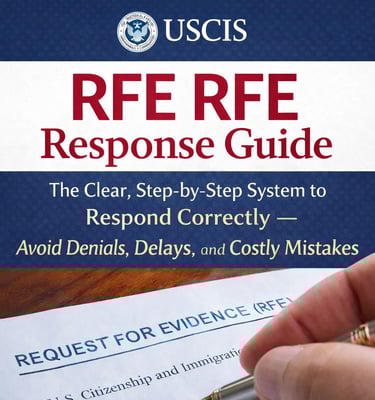
👉 The USCIS RFE Response Guide helps you understand RFEs before they lead to denial and shows you how to recover strategically after denial — preserving credibility and future opportunity — in over 60 pages of clear, practical guidance.
The right move after denial
is rarely the fastest one.
Final Thought
An RFE denial is not the end — but it redefines the terrain.
What you do next determines whether that denial:
Becomes a footnote
Or becomes a pattern
Protect the record.
Change strategy.
Think long-term.
That’s how smart applicants move forward.https://uscissrfehelpusa.com/uscis-rfe-guide
Help
Guiding you through every step smoothly
Contact
infoebookusa@aol.com
© 2026. All rights reserved.